Construction Project Change Management: A Practical Guide
Construction Project Change Management: A Practical Guide ! Team collaborating on construction change management Construction project change management is the systematic process of controlling modifications to a project’s agreed scope, schedule, budget, or resources to protect financial outcomes and keep all parties aligned.
Construction Project Change Management: A Practical Guide

Construction project change management is the systematic process of controlling modifications to a project’s agreed scope, schedule, budget, or resources to protect financial outcomes and keep all parties aligned. Every construction project faces changes. The question is whether your team manages them or reacts to them after the damage is done. Unmanaged changes are the leading cause of cost overruns, schedule delays, and contractor disputes. Understanding what is construction project change management, and applying a structured process, is the difference between a project that finishes on budget and one that ends in litigation.
What is construction project change management?
Construction project change management is the formal discipline of identifying, documenting, evaluating, approving, and recording every modification to a project’s original contract. The industry term for the legal instrument that executes each approved change is a change order. Change orders legally modify contract scope, schedule, and budget without restarting the bidding process. That flexibility is valuable, but it requires disciplined management or costs spiral fast.
Change management in construction is not just paperwork. It is a governance system that connects every scope shift to a financial and schedule impact before any work begins. Organizations like the American Institute of Architects (AIA) and the Construction Industry Institute (CII) have developed standardized contract frameworks and process guides precisely because uncontrolled changes destroy project outcomes. The AIA A201 General Conditions, for example, defines the formal change order process that most commercial contracts follow.

What causes construction project changes?
Changes in construction projects come from several predictable sources. Key drivers include technical, cultural, and financial factors, including volatile market pricing. Understanding the root cause of a change determines how to price it, who bears the cost, and how to prevent it on the next project.
The most common sources of construction project changes are:
-
Design evolution: Incomplete drawings or late design decisions force field modifications.
-
Client scope modifications: Owners change program requirements after construction begins.
-
Unforeseen site conditions: Subsurface issues, contamination, or existing structure conflicts.
-
Market volatility: Material price escalation or supply chain disruptions alter cost assumptions.
-
Poor planning: Inadequate pre-construction coordination creates gaps that surface as change orders.
Approximately 73% of construction organizations are actively seeking better, structured processes to manage scope changes because they are the leading cause of disputes and budget overruns. That statistic reflects a systemic problem. Most project teams know changes are coming but lack the process to catch them early enough to control the outcome.
Pro Tip: Include a change management clause in every contract before mobilization. Define who can authorize changes, what documentation is required, and the timeline for response. Ambiguity in the contract becomes a dispute in the field.
What are the key stages of a change management process?
An effective construction change management process follows a defined sequence. Each stage has a specific purpose and set of activities that prevent changes from becoming uncontrolled cost events.
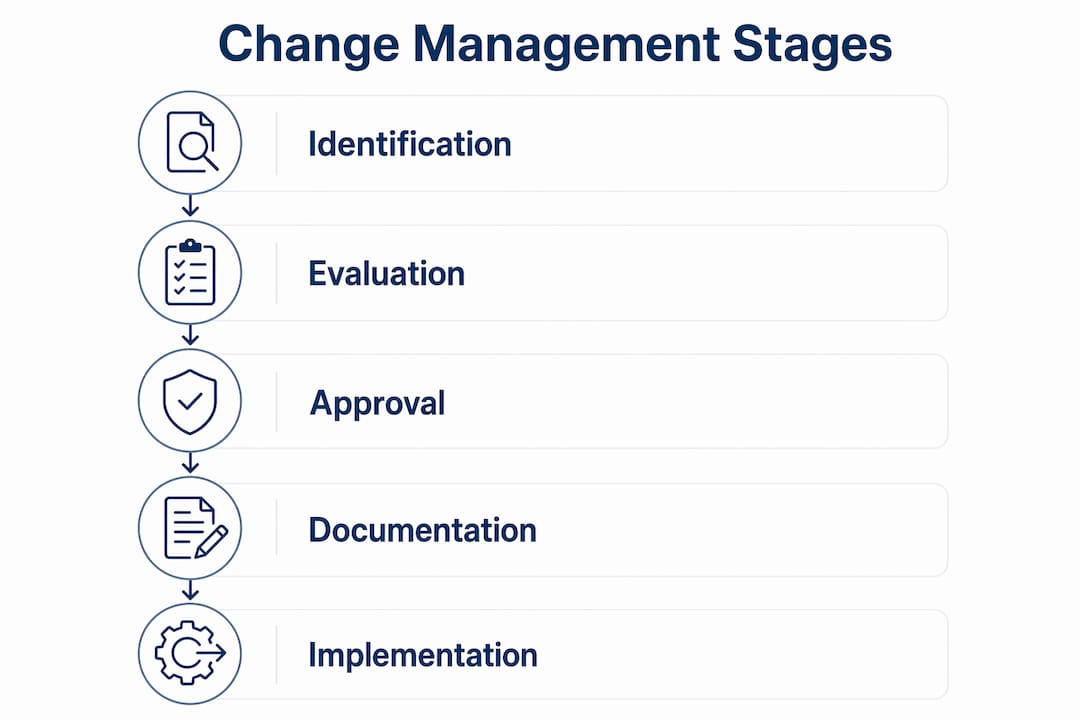
| Stage | Purpose | Key Activities |
|---|---|---|
| Change identification | Catch shifts early | Trend logging, site observations, design reviews |
| Change request | Formalize the modification | Written request with scope description and justification |
| Impact analysis | Quantify cost and schedule effects | Pricing, schedule modeling, resource assessment |
| Approval workflow | Align stakeholders before work starts | Owner, architect, and contractor sign-off |
| Change order execution | Legally modify the contract | Signed change order with updated contract sum and dates |
| Recordkeeping | Maintain project controls integrity | Update budget, schedule baseline, and project log |
| Lessons learned | Improve future performance | Root cause analysis and process refinement |
The impact analysis stage is where most teams underestimate the work. Most change requests have ripple effects impacting resource allocation, procurement, and critical path scheduling, not just immediate costs. A single scope addition can delay a subcontractor’s mobilization, push a material delivery, and compress the schedule for three downstream trades. Pricing only the direct labor and material cost misses the full financial exposure.
Change request documentation must include a detailed scope description, the reason for the change, the cost impact broken down by labor, material, and equipment, and the schedule impact in calendar days. Vague change requests create disputes at closeout. The more specific the documentation, the faster the approval and the cleaner the project record.
How does proactive change management differ from reactive approaches?
Proactive change management means identifying and addressing shifts before they become formal change orders. Reactive change management treats change orders as after-the-fact paperwork filed once the work is already done or the dispute has already started.
Proactive management identifies changes early through governance and data-driven insights at design milestones, rather than just restricting changes. The practical tool for this is trend logging, a running register of potential changes that have not yet been formally submitted. Trend logging helps track potential changes before formal requests, preventing hidden cost “iceberg effects” late in a project. The iceberg effect is real: the visible cost of a change is often a fraction of the total impact once schedule disruption, rework, and overhead are included.
The dangers of a reactive approach are concrete:
-
Financial exposure from unpriced work already completed
-
Legal risk when verbal instructions replace written change orders
-
Schedule chaos when downstream trades are not notified of scope shifts
-
Disputes at project closeout when the record does not match the field
“Change management should be viewed as an integrated process combining governance, data analytics, and early communication rather than merely restricting changes.” — Construction Industry Alliance for Responsible Contracting (COAA)
Treating change orders as reactive administrative tasks exposes contractors to excessive financial and legal risk and erodes profitability. The project team that waits for the owner to raise a change has already lost negotiating leverage. The team that logs the trend, prices the impact, and presents a formal request early controls the outcome.
Pro Tip: Hold a weekly change order status meeting with the owner and architect. Review the trend log, confirm pending approvals, and close out any open items. This single habit prevents the backlog of unresolved changes that turns into a claim at project end.
What are the best practices for managing construction project changes?
The most effective change management programs share a small set of non-negotiable practices. These are not suggestions. They are the behaviors that separate projects that close cleanly from those that end in arbitration.
-
No work starts without written approval. Performing work based on verbal orders risks losing leverage and results in uncompensated work or eroded profit margins. A verbal instruction from an architect or owner representative is not a change order. Treat it as a request and respond with a written proposal.
-
Price every change with full detail. Break down labor hours, material quantities, equipment costs, and subcontractor markups. Lump-sum change order pricing invites disputes. Detailed pricing is harder to reject and easier to defend.
-
Process change orders at the time of request. Delaying change order processing drives claim-related disputes. Scope amendments executed at the time of request prevent billing inaccuracies and keep the project record clean.
-
Maintain a change order log visible to all stakeholders. Every open change request should show its status, dollar value, schedule impact, and responsible party. Visibility creates accountability.
-
Use standardized contract language. AIA contracts, ConsensusDocs, and EJCDC forms all include defined change order processes. Projects using these frameworks have fewer disputes because the rules are agreed upon before the first shovel hits the ground.
-
Train your team before the project starts. Most change order failures are not contractual. They are behavioral. A project kickoff session that walks every team member through the change management process reduces resistance and improves compliance throughout the project.
Pro Tip: Build a change order readiness checklist into your project startup package. Include the authorization matrix, documentation requirements, response timelines, and the trend log template. Teams that start with the process in place execute it consistently.
Key Takeaways
Effective construction change management requires a formal, documented process that begins before the first change request arrives and runs continuously through project closeout.
| Point | Details |
|---|---|
| Define change management early | Establish authorization, documentation, and response requirements in the contract before mobilization. |
| Use trend logging proactively | Track potential changes before formal requests to prevent hidden cost and schedule overruns. |
| Never start work without approval | Verbal instructions do not create enforceable change orders and lead to uncompensated work. |
| Process changes at the time of request | Delayed approvals cause billing inaccuracies and increase the risk of claim disputes. |
| Price changes with full detail | Break down labor, material, and schedule impacts to reduce disputes and protect profit margins. |
Change management is a system, not a form
After years of working on the owner’s side of capital projects, the pattern I see most often is not a lack of knowledge about change management. It is a lack of discipline in executing it consistently. Teams know they need written change orders. They do it anyway on a handshake because the relationship feels solid or the schedule pressure is real. That is where projects unravel.
The iceberg effect is the most underappreciated concept in construction finance. A $50,000 scope addition looks manageable on its face. But when it delays a mechanical subcontractor by two weeks, pushes the ceiling installation, and compresses the final inspection window, the real cost is three times the direct number. Teams that do not use trend logging never see the full iceberg until it is too late to price it accurately.
The other lesson I keep coming back to is that change management is a culture, not a checklist. The project teams that execute it well have leaders who treat every change request as a financial event requiring the same rigor as the original contract. They do not apologize for the process. They enforce it consistently, from the first RFI to the final punch list. That consistency is what protects the budget, the schedule, and the relationship with the owner.
— Ryan
How Siteops360 helps you control project changes
Managing changes across multiple concurrent projects without a centralized system means critical approvals fall through the cracks and cost impacts go untracked until closeout.
Siteops360 is built specifically for owner’s representatives and project owners who need complete oversight of change orders, budget impacts, and approval workflows in one place. The platform centralizes change order tracking, cost forecasting, contract execution with e-signature, and real-time reporting so your team always knows what is approved, what is pending, and what is at risk. Its accountability model shows exactly what is in your court versus what you have handed off, so nothing stalls. Our change order process also allows you to submit change orders for external users to sign via e-signature before it even reaches the project executives. If you are managing capital projects and want to replace scattered emails / spreadsheets with a clear, owner-ready dashboard, Siteops360 is built for that job.
FAQ
What is construction project change management?
Construction project change management is the formal process of identifying, documenting, evaluating, approving, and recording every modification to a project’s original contract scope, schedule, or budget. It uses change orders as the legal instrument to execute approved modifications.
What is a change order in construction?
A change order is a written contract amendment that modifies the original scope, price, or schedule of a construction agreement. Change orders legally modify the contract without restarting the bidding process, but require signed approval from all parties before work begins.
Why do construction projects have so many changes?
Changes arise from incomplete design documents, unforeseen site conditions, client scope modifications, regulatory updates, and market price volatility. Poor pre-construction planning is one of the most common and preventable causes.
What is the difference between proactive and reactive change management?
Proactive change management uses trend logging and early stakeholder communication to identify and price changes before they escalate. Reactive change management treats change orders as administrative tasks filed after the work is done, which increases financial and legal exposure.
What happens if you start work without a signed change order?
Starting work based on a verbal instruction risks losing the right to compensation. Performing work without written approval leads to uncompensated work, eroded profit margins, and disputes that are difficult to resolve at project closeout.